Infrastructure By Industry Retail
Vertical · Retail

Every store on the same standard.

Retail networking lives or dies on two things: consistency across hundreds of stores and resilience when a single circuit cuts out. Netcom designs the reference architecture once, ships pre-staged kits to every store, and keeps them all on the same firmware track.

PCI v4.0
scope-minimizing VLAN design so POS isn't comingled with guest or back-office
<14 days
new-store turn-up from procurement to live, once the reference stack is set
Verizon
Preferred Partner for cellular failover at every store, single-pane SIM management
Retail · SMB Reference
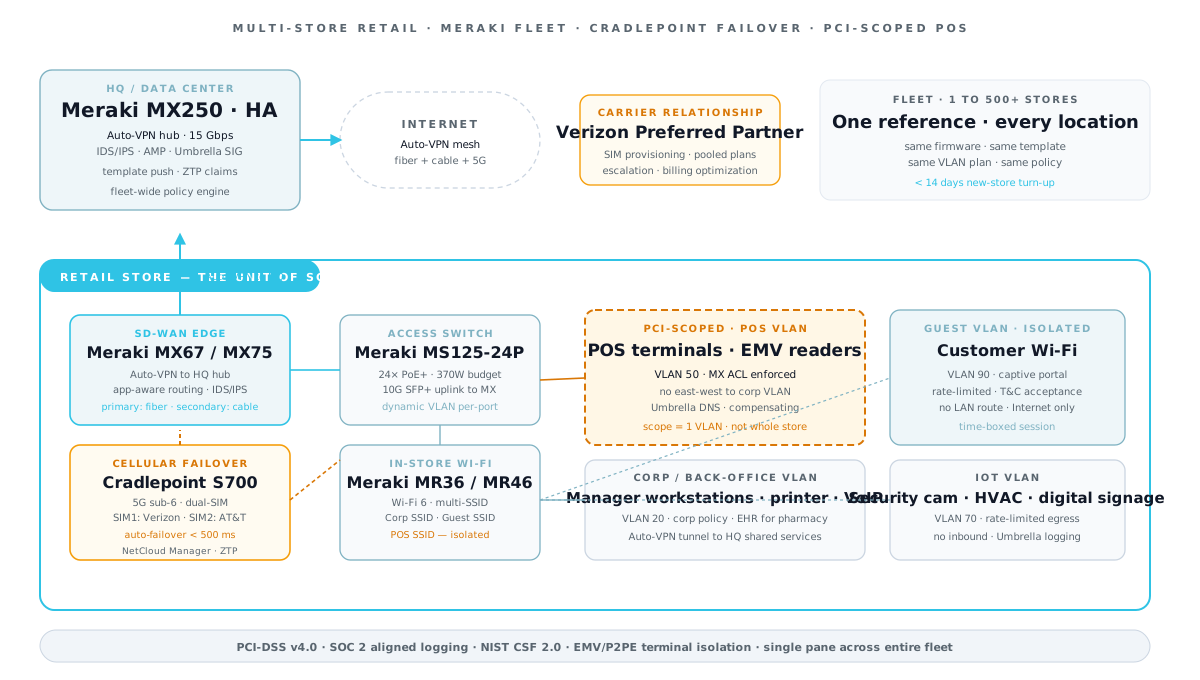
Retail reference architecture: HQ Meraki MX250 hub, Auto-VPN to Meraki MX67 in stores with Cradlepoint S700 5G failover, and isolated PCI POS VLAN boundary
Retail-specific pain

Every store is a network. Multiply that by 500.

The hard problem in retail networking isn't any single store — it's keeping 500 of them configured the same, running the same firmware, authenticating against the same policy, and uniformly PCI-compliant. The moment you allow drift, you accumulate audit findings and troubleshoot nightmares that take weeks to untangle.

The second hard problem is opening new stores at pace. A five-week network lead time kills a 30-day store-opening schedule. We've seen retailers lose entire locations off the calendar because the WAN circuit ordered on Week 1 didn't turn up on Week 4. Cellular-primary or cellular-assist is how modern retail chains open stores on an aggressive calendar and convert to wired when fiber catches up.

Netcom designs retail networks as a fleet, not as individual sites. One reference architecture. One firmware track. One policy template. Zero-touch provisioning to every new store. Cellular failover at every store. Dashboard visibility across the whole estate. When store 412 goes dark, you know within 60 seconds and our NOC partner has triaged before a manager has called.

Designed to audit cleanly.

PCI-DSS v4.0 scope minimization
SOC 2 Type II aligned logging
NIST CSF 2.0 mapping
State-level privacy (CCPA/CPRA/VCDPA)
EMV/P2PE payment terminal isolation

The store-in-a-box.

Designed for 1-to-500+ store chains. Every component sized for a typical 2,500-to-8,000 sq ft location; adjustments noted where store footprint diverges.

Retail store-in-a-box: Meraki MX67 SD-WAN edge, MS125-24P PoE switch, MR36/MR46 Wi-Fi, Cradlepoint S700 cellular failover, with PCI-scoped POS VLAN isolated from guest and corp VLANs
Retail · typical 2,500–8,000 sq ft · 2–8 POS · 10–40 employees

Meraki-native stack with Cradlepoint failover

Cloud-managed SD-WAN from the HQ down. Zero-touch provisioning to every store: the boxes ship pre-claimed, the new-store manager plugs in power and uplink, the dashboard pushes the template, and the store is live. Cellular failover is Cradlepoint S700 with a Verizon-primary SIM and an AT&T or T-Mobile secondary for carrier diversity. PCI scope is contained to a dedicated POS VLAN with access-list enforcement in the MX.

RoleVendor & ModelNotesLicense
Store SD-WAN edgeCisco Meraki MX67 / MX75Auto-VPN to HQ hub · IDS/IPS · app routingAdvanced Security
Store switchMeraki MS125-24P24× PoE+ · supports APs + VoIP + security camEnterprise
In-store Wi-FiMeraki MR36 / MR46Guest SSID + Corp SSID + POS SSID (isolated)Enterprise
Cellular failoverCradlepoint S7005G · dual-SIM Verizon + AT&T/T-MobileNetCloud Essentials
HQ SD-WAN hubMeraki MX250 (HA pair)15 Gbps threat-inspected · Auto-VPN meshAdvanced Security
POS segmentationVLAN + MX ACL + Umbrella DNSNo east-west to corp VLAN · DNS-layer protectionUmbrella SIG
Guest Wi-FiCaptive portal · bandwidth cap · no-VPN-backTerms acceptance · time-boxed sessionIncluded
Remote mgmtMeraki Dashboard + Cradlepoint NetCloudFleet view · alerting · firmware orchestrationPer-device

Composite examples from retail engagements.

Illustrative customers drawn from real deployment patterns. Names are fictional; scope, vendors, and outcomes reflect actual Netcom work.

Outdoor-Recreation Retail

Ridgeline Outdoor Co. · 120-store SD-WAN refresh

Inherited MPLS from three acquisitions, 120 stores on three different vendors, no uniform firmware track, PCI scope bleeding across the whole LAN. Netcom designed a single Meraki reference architecture, staged every box at our DC, shipped pre-configured in wave sequence. The real-world path: the existing MPLS wouldn't terminate early without penalty, so dual-path ran in parallel for the first 90 days. Four rural stores couldn't get usable Verizon 5G and fell back to AT&T fixed wireless. Wave 2 hit a Meraki firmware regression — we rolled back 18 stores overnight and pinned a known-good template version before resuming. Finished on 14-week plan despite the pivots.

99.98%
target uptime with
dual-transport + 5G failover
Specialty Retail · 80 locations

Parkside Pet Supply · ISP consolidation + new-store cellular

Retailer opening 12 new stores per year on fiber timelines that wouldn't hit. Netcom deployed Cradlepoint E3000 as primary 5G for new-store openings day-one. What we got wrong initially: we sized the first three openings on Verizon Business Unlimited plans and watched two of them burn through the fair-use threshold in 11 days under opening-week video traffic. Rebuilt the deployment kit on pooled IoT plans with a shared data bucket; usage smoothed out across the fleet. Seven stores opened on time where they would have missed; six stayed on cellular-primary by choice after the economics penciled.

Day 1
new-store turn-up
on 5G primary
Specialty Food · 35 locations

Monarch Specialty Foods · PCI scope reduction

Audit finding: guest Wi-Fi and POS shared broadcast domain in older stores. Netcom retrofitted VLAN segmentation with ACL enforcement, moved POS to a dedicated SSID with certificate-based auth, added Umbrella DNS as compensating control. Scope creep mid-project: discovered three stores still had legacy card readers that couldn't do 802.1X cert auth. Had to keep those on a pre-shared key SSID with additional MAC filtering as a compensating control and get QSA sign-off before move-in. Six-week project stretched to nine; PCI scope still collapsed from whole-LAN to POS-VLAN.

1 VLAN
PCI scope, down from
entire store LAN

Ready to standardize the fleet?

Send us your store count, current vendor mix, and rough footprint. Within 10 business days you'll get a reference architecture, a staging model, and a phased cutover plan.